Screech, Click, You've Got Mail: The Dial-Up Sound That Rewired a Generation's Brain
Screech, Click, You've Got Mail: The Dial-Up Sound That Rewired a Generation's Brain
Let's be honest about something: the dial-up modem connection sound is objectively terrible. It's a sequence of tones that, if played in a public place today, would cause younger generations to physically recoil and older ones to go briefly catatonic, eyes glazed, transported against their will back to 1998. It sounds like a robot gargling gravel while a smoke alarm goes off in the background. It is, by any reasonable acoustic standard, an assault.
And yet. And yet.
Millions of Americans hear that sound and feel something warm in their chest. Something almost like home. This is the completely irrational, entirely understandable story of how a telecommunications handshake protocol became the Proustian madeleine of an entire internet generation.
The Ritual Before the Internet
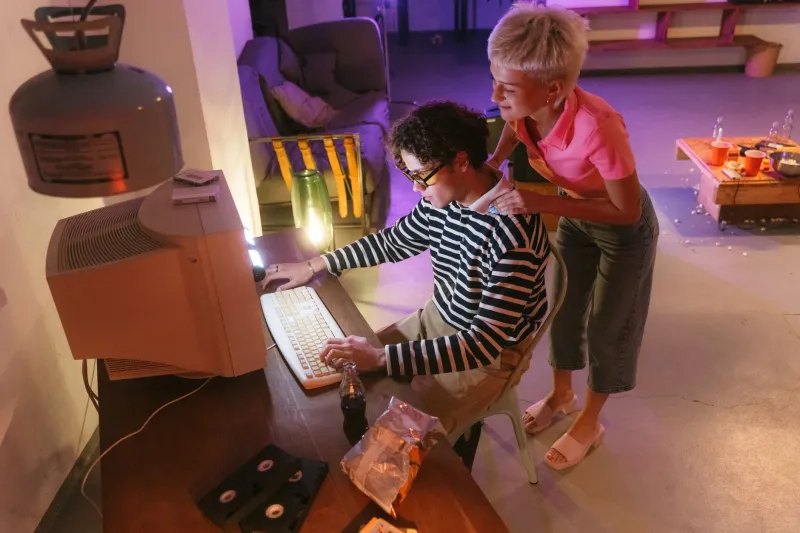
If you were online in the mid-to-late 1990s, you didn't just get on the internet. You prepared for the internet. There was a whole pre-show.
First, you had to check whether anyone was on the phone. Not metaphorically — literally, you had to pick up the receiver and listen. Because your modem used the same physical line as your family's landline, and if your mom was chatting with Aunt Linda, you were going to have to wait. This was your first lesson in network congestion, taught not by a textbook but by the crushing disappointment of hearing a dial tone that immediately gave way to a human voice saying, "Hold on, someone's picking up."
Then came the ritual itself. You'd double-click the AOL icon — that little yellow running man, eternally sprinting toward something, never arriving — and the modem would wake up. What followed was approximately 30 to 45 seconds of sounds that defied easy categorization: an initial dial tone, then the number being dialed in rapid beeps, then the moment of contact, which sounded like two electronic entities meeting for the first time and absolutely hating each other. Squeals, scratches, the infamous KSHHHHH, a series of negotiating tones, and finally — finally — the warm resolution of a successful handshake.
And then: "Welcome."
And then, if the universe was kind: "You've got mail."
The Voice of God (His Name Was Elwood Edwards)
Here's a piece of internet history that sounds made up but absolutely isn't: the man who recorded "You've got mail" — along with "Welcome," "Goodbye," and "File's done" — did so in his living room in 1989, at the request of his wife, who worked for the company that would eventually become AOL. His name is Elwood Edwards, he's a real person who still does public appearances, and he recorded those four phrases onto a cassette tape that his wife brought into the office.
For a significant portion of the 1990s and early 2000s, Elwood Edwards's voice was the most-heard voice in America. More than any news anchor, more than any radio DJ. Every time someone successfully navigated the screech-and-handshake gauntlet and landed in their AOL inbox, Elwood was there to greet them. He was the friendly face — or rather, friendly baritone — of the early internet. The whole thing is either deeply wholesome or profoundly surreal depending on your mood.
Tom Hanks and Meg Ryan made an entire movie around the phrase in 1998. Elwood Edwards received no royalties. The internet, even in its infancy, had complicated feelings about compensating creators.
The Shared Household Internet Economy
One aspect of dial-up life that younger users genuinely cannot fathom is the scarcity negotiation that happened inside American homes every single evening. The internet was not a utility you could all use simultaneously. It was a single resource, accessed through a single phone line, and someone was going to get it and someone was not.
This created an entire domestic political system. Older siblings weaponized their size. Parents deployed the nuclear option of "I'm expecting a call." Younger kids learned to wait, hovering, watching the clock, calculating when exactly their window would open. The family computer — singular, located in the living room or a shared office, never in a private bedroom — was a contested territory.
And God help you if someone picked up the extension phone mid-session. The connection would drop. The modem would disconnect. You'd have to start the whole ritual over again. This was treated, within the home, with roughly the same gravity as a minor natural disaster.
Buffering as Character Development
Here's the thing about dial-up internet that nobody talks about in polite company: it made you wait. Not the modern kind of waiting, where a page takes 1.3 seconds instead of 0.4 and you feel a flicker of impatience. Real waiting. A single image — one JPEG of, say, a celebrity or a funny cat — might take two full minutes to load, rendering itself in horizontal strips from top to bottom like a very slow reveal on a game show.
This had consequences. You had to want something to bother loading it. You developed patience not as a virtue but as a survival mechanism. You learned to read while you waited. You'd open a page, walk to the kitchen, make a snack, come back, and maybe — maybe — the image would be halfway done.
Whether this built character or simply built tolerance for frustration is a matter of genuine debate among people who grew up in that era. What's less debatable is that the friction made every successful internet experience feel earned. You didn't stumble onto content. You retrieved it, at great personal cost, and you valued it accordingly.
The Sound Comes Back
Somewhere around the mid-2010s, a funny thing started happening on YouTube and later TikTok: people started posting dial-up modem sounds on purpose. Not as jokes, exactly, though there was humor involved. As ASMR. As nostalgia content. As the audio equivalent of a comfort blanket.
Videos titled things like "AOL dial-up sound — 10 hours" accumulated millions of views. Reddit threads asking "does anyone else find the modem sound weirdly relaxing?" would fill up with thousands of comments from people in their 30s and 40s saying yes, absolutely, immediately, without hesitation.
The screeching handshake that once represented the bleeding edge of consumer technology had become, within a single generation, a soothing relic. Meme accounts used it as audio shorthand for "old internet." Brands deployed it ironically to signal retro awareness. Elwood Edwards got a TikTok account and went viral multiple times.
The dial-up sound had completed its transformation from utility to aesthetic.
What We Actually Miss
It would be easy — and slightly wrong — to say what people miss is the sound itself. What they actually miss is probably everything around the sound. The anticipation. The ritual. The sense that getting online was an event rather than a background condition of existence. The family computer in the shared room. The away messages. The buddy lists. The feeling that the internet was a place you went rather than a medium you simply inhabited.
The screeching modem was the door. And like all doors, it's not the door you're nostalgic for — it's everything that was on the other side.
Also, if we're being completely honest, "You've got mail" delivered in Elwood Edwards's calm, reassuring baritone is genuinely one of the most comforting phrases in American cultural history. Don't @ us. He earned it.