Gallery of the Broken-Hearted: How DeviantArt Raised a Generation of Weirdos and Why That Was Exactly Right
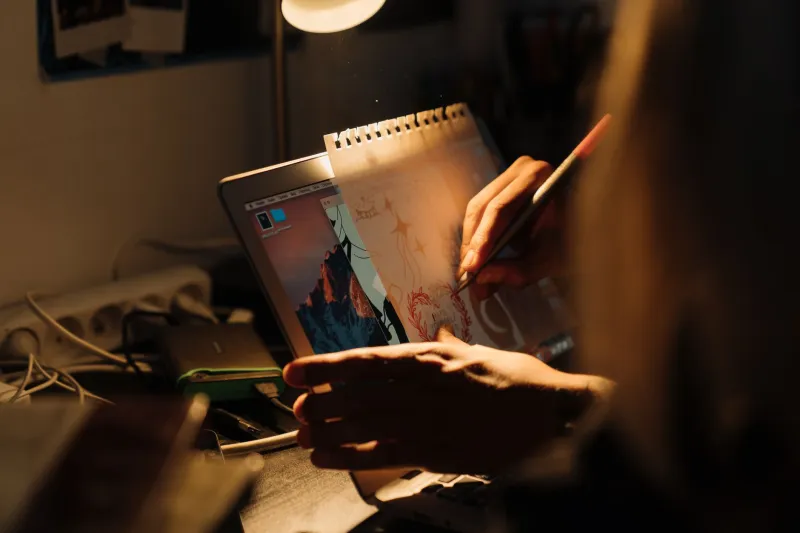
Somewhere right now, buried in a folder on an old hard drive or still technically live on a server that has no business still existing, is a piece of art you made when you were fourteen. Maybe it was a pencil sketch of your favorite anime character, scanned with a printer that cost your parents three hundred dollars and produced the visual quality of a fever dream. Maybe it was a photograph of your own hand reaching toward a foggy window, watermarked with your username in Impact font. Maybe it was a poem illustrated with a stock photo of a girl standing in a field, filtered to within an inch of its life in GIMP because Photoshop was forty dollars a month and you were in eighth grade.
Wherever that piece of art is, there is a nonzero chance it once lived on DeviantArt — and that someone, somewhere, left a comment on it that said "nice work!! :heart:" and absolutely made your entire week.
What DeviantArt Actually Was, For the Uninitiated
Founded in 2000 by a trio of people who probably did not anticipate launching the emotional infrastructure of an entire generation, DeviantArt billed itself as an online art community. That description is technically accurate the same way calling the Grand Canyon a "hole" is technically accurate. By the mid-2000s, the platform had become something far stranger and more significant: a sprawling, loosely organized republic of creative output where millions of teenagers posted drawings, digital paintings, photography, fanfiction cover art, and journal entries that would make a therapist both concerned and deeply moved.
There was no algorithm curating your experience. There was no engagement metric whispering in your ear that you needed seventeen hundred likes to be considered a real artist. There was just a gallery, a username you'd chosen at thirteen and would spend years slightly regretting, and the quiet, terrifying freedom to put your work in front of strangers.
The Follower Count That Wasn't
Here's the thing about DeviantArt that sounds minor until you think about it for thirty seconds: the primary social action on the platform was called "watching" someone. Not following. Watching. You watched a gallery the way you watched a TV show — because you genuinely wanted to see what came next, not because an algorithm had suggested that watching this person would optimize your personal brand.
The distinction matters more than it sounds. In today's creator economy, follower counts are currency, leverage, and self-worth all compressed into a single number. On DeviantArt circa 2006, having forty-seven watchers meant forty-seven actual humans had decided, of their own free will, that your art was worth returning to. It was intimate in a way that 50,000 Instagram followers will never be. Those forty-seven people knew your username. They remembered your old style. They'd watched you get better, or weirder, or both.
The Comment Section as Unlikely Safe Space
DeviantArt's comment culture was, by any modern standard, an absolute disaster waiting to happen. It was unmoderated, earnest to the point of being almost painful, and completely dominated by teenagers who typed in all lowercase and used tilde symbols as punctuation. It was also, somehow, one of the most genuinely encouraging creative environments the internet has ever produced.
Part of this was structural. DeviantArt was not a platform built for virality. Nothing you posted was going to get ratioed. Nothing was going to get screenshotted and dropped into a group chat as an example of cringe. The worst-case scenario for most posts was silence — and even silence on DeviantArt didn't carry the specific social humiliation of silence on platforms built explicitly around popularity metrics.
So people commented kindly. Not always insightfully, and not always correctly, but kindly. "I love the shading on the wings" from a stranger who also drew wings badly was somehow more sustaining than any number of algorithmically surfaced likes. You knew they'd looked. You knew they'd felt something specific enough to type it out.
Fanfiction, Fursuits, and the Total Absence of Shame
DeviantArt was also, crucially, a place where niche was not a liability. The platform's categorical chaos — you could browse by medium, by subject, by fandom, by a dozen other filters that made sense only if you already knew what you were looking for — meant that the weirdest, most specific creative work could find its weirdest, most specific audience.
Fan art communities built entire parallel economies of creative output. Sonic the Hedgehog fan artists developed distinct styles that influenced each other across years. Original character designers (OC creators, in the parlance of the time) built elaborate backstories for characters that existed nowhere except in their own galleries and the imagination of their watchers. Furry artists, emo photographers, fantasy illustrators, and people who exclusively drew their favorite band members in period-accurate Victorian clothing all coexisted in the same enormous, slightly broken house.
Nobody called any of this "content creation." That phrase would have landed on DeviantArt like a foreign object. This was just... making things. Putting them somewhere. Seeing what happened.
What It Actually Did to a Generation
Here is the argument that is worth making seriously, even on a website that is mostly here to have fun: DeviantArt accidentally functioned as one of the most effective creative development platforms ever built, precisely because it was never optimized for anything.
Teenagers who posted there learned to finish things. They learned to handle the silence when a piece didn't connect. They learned to iterate, to develop a style, to watch other artists and absorb techniques without it being called stealing. They learned that sharing imperfect work was survivable, and that the version of yourself who made something embarrassing at fourteen was not the version who would be making things at twenty-four.
They also, and this part gets overlooked, learned to be an audience. To leave comments. To watch someone's growth over years and feel invested in it. To experience art made by people who looked and felt and struggled the way they did, without a curatorial layer deciding what was worth their attention.
The Platform Today, and Why the Feeling Doesn't Transfer
DeviantArt still exists. It has been acquired, redesigned, and subjected to the usual indignities of platforms that survive long enough to get purchased by people who want to monetize them. There is now an AI art controversy, because of course there is. The interface has been modernized in ways that have made longtime users audibly sad.
But the thing DeviantArt was — that accidental, chaotic, deeply human creative commons — doesn't really exist anywhere anymore. Not in the same form. Instagram is too curated, too metric-driven, too beautiful. TikTok moves too fast for the slow, iterative relationship between an artist and their audience that DeviantArt made possible. Even the corners of the internet that try to replicate the feeling tend to do so self-consciously, which immediately makes it something different.
The original was never trying to be anything. It was just a place. And a whole generation of people who needed a place found it there, posted their weird art into it, got a comment that said "this is beautiful :rose:" from someone in a different time zone, and kept going.
Which, honestly, is more than most platforms can say.